FOR THE LOVE OF WISDOM
Man is an inquiring animal. Since the day he developed the power of reflection, he has always posed questions about himself, the world around him, and the purpose and meaning of his existence. Driven as though by a curiosity to know, man has never stopped searching through the ages for an answer to his fundamental queries, to his never-ending quest for knowledge and truth that the spirit of philosophy was born.
Philosophy as part of College or University curriculum still confused many, those who had taken the course and those who intend to take it. For the term Philosophy, in the Filipino mind set, generally connotes fallacious reasoning, id est, Pilosopo.
In the Hiligaynon dialect, Pilosopo is always confused with bertuldo. The latter being the intentional-intellectual act of deceiving another through stealthy changing the meaning of terms for the sake of fun or just sound intelligent. We have had experienced people who are fond of this. As: Malakat ta sa La Salle! And someone answers: Ikaw lang to lakat masakay kami ya! Gaulan mani! Someone answers: manalud ta e, another declares: binaho ta e, then, maligo ta e, mabaho nag id ta e!!! “Kaon anay.” Sigi lang tyay kan-on ya amon ginaka-on”, Kamusta ka? “Mayo man”- Paano nag mayo kay Abril man subong”.
The word philosophy come from the Greek words, philo (love) and sophia (wisdom), and thus, it signifies 'love of wisdom'. This notion of philosophy has always been understood since time immemorial as the serious quest for knowledge of the material world and the endeavor to live 'the good life'. The quest for knowledge in philosophy was never meant to be the easy acceptance of, or conformity to, traditional views or practices. Philosophic knowledge is acquired, as the great philosopher Socrates suggested, through critical inquiry and independent reflection. Thus, if one hopes to have a philosophical understanding of the world and man's place in it, one must appeal to reason rather than to authority, be it tradition or revelation. The search for truth in the realm of philosophy is such a radical venture, that in the process, it may summon to the bar of reason even time- honored beliefs, assumptions and practices of the society. For, as the noted scientist and philosopher Faraday has put it.
...the philosopher should be a man willing to every suggestion, but determined to judge for himself...He should not be biased by appearances; have no favorite hypothesis, be of no school, and in doctrines have no master. He should not be a respecter of person, but of things. Truth should be his primary object.
This critical nature of philosophy may, indeed, prove irreverent and disturbing to many people, specially to those who love intellectual complacency and conformity to established thought. For people, however, who have the passion for critical inquiry, and therefore for the progress of knowledge, philosophy is certainly an exciting and fascinating intellectual adventure.
This is an attempt to make Philosophy deeply appreciated. Again, this is only an attempt to make Philosophy fun to learn and practical to do as well as practical in life. So let us have fun and learn. Or learn to have fun while learning!
FOUR MAIN BRANCHES OF PHILOSOPHY AND ITS CORE SUBJECTS
1. Logic – the science of correct thinking.
2. Ethics – the science of the morality of human acts.
3. Epistemology – the theory of knowledge, the goal of which is truth.
4. Metaphysics – the foundation subject of all philosophy, it deals with human reality and system of human thought that seeks to explain the fundamental concepts of man.
5. Cosmology – the study of inanimate things such as the universe, from the philosophical viewpoint.
6. Aesthetics – the study of beautiful.
7. Rational or philosophical Psychology – the study of life principle of living things, specifically that of man.
8. Theodicy – the philosophical study of God.
9. Social Philosophy – the study of man in relation to the family, the State and the Church.
10.Philosophy of Man – the inquiry into man and his dimensions as persons an as existent being in the world : his dignity, truth, freedom, love, death, his relations with others and with God.
Logic as a science
When one is asked about “science,” he immediately associates it with different empirical sciences like chemistry, anatomy, physiology, physics, astronomy, biology and the like. Such an association is partly correct because all those disciplines are indeed sciences. Yet, it is also partly incorrect if it is assumed that there are no other forms of science except the empirical sciences. In other words, the term “sciences” has a universal applicability; its meaning must not be confined to the scope of the empirical sciences alone.
Science, in general, may be described as a branch of knowledge that systematizes facts, principles and methods. Following this this description, it is evident why the empirical sciences are called such. All of them have a particular object of study that requires a systematization of facts, principles and methods to ensure a greater degree of knowledge about the particular object of study. In addition, here are some other characteristics of science according to Andrew Bacchuber, SJ.
Science is:
Not mere opinion or hypothesis but certain and demonstrated knowledge
Not mere accumulation or aggregation of knowledge but organized knowledge
Not a bare statement of fact or mere description of events but casual knowledge that explains why things are as they are.
It uncovers fundamental causes of certain phenomena.
Considering all these, Logic can also be considered a science. Following the given description, it can be said that Logic investigates are the facts concerning correct thinking. “Logic systematizes these facts, formulates rules and principles along with methods in order to come up with certain and demonstrated knowledge.” The rules of Logic are not mere mechanical rules; the rules are explained and elaborated to indicate why the rules of Logic ought to be that way. In short, the rules of Logic are mean to show how thinking becomes correct if such rules are followed and how thinking becomes incorrect if the rules of Logic are violated. In the same manner, the knowledge that Logic seeks is organized knowledge. The science of Logic does not merely provide a set of rules, which are not related to other rules. All the rules are so tied up with one another that the understanding of one rule may be a prerequisite for another. As we further our study of logic, we will see this interconnection. The principles discussed in the beginning of the course will constantly be used until the end. This is true because the science of Logic is an organized form of knowledge.
Lastly, Logic, as a science, shows why a certain form of reasoning is correct or incorrect. This is the reason why Logic is regarded as a form of casual knowledge: it demonstrates why an argument is logical or illogical based on the scientific rules formulated by logicians. It shows the cause of reasoning is defective.
From all these considerations, it can be noted that although Logic is not an empirical science, it can still be regarded as a science insofar as it meets the standards of science in the widest sense of the term.
Logic is an Art
“Art” denotes a skillful production or performance of something that has order, form of beauty. The skill involved in any form of art- be it sculpting, painting, cooking, composing, choreographing, film making and so on. It requires correct judgment in order that the product may be cheated perfectly of the performance be executed flawlessly. With a mastery of skills, an artist proceeds with easily if the one performing it is the artist himself. A non-musician, for instance, will find it difficult to compose a musical piece. It is equally difficult for non-dancer to execute graceful dance steps immediately. Somebody who does not know how to cook may spoil the food if he attempts to prepare a dish that involves complicated recipes. In short, if a non-artist performs an art, it may become a burdensome ordeal. On the contrary, if the expert is the one engaged in it, the performance comes out very spontaneously, even as spontaneous as one’s breathing. Observe that artists who can perform their craft very easily because they have already acquired mastery of their skills; their craft is their art.
Logic is also an art because it requires the performance of a very important feat: correct thinking. Man is capable of thinking; but since he does not think correctly all the time, he is prone to errors. If a person studies Logic diligently, there is no reason why he cannot think correctly and easily. Thinking correctly may be difficult for one who is not accustomed to doing it; but just like any art, the difficulty occurs while one is still in the process of perfecting the craft. A popular saying states that “practice makes perfect.” Even the most renowned artists will not claim that they have acquired mastery of their craft overnight. A great deal of patience is required in order to perfect their skills. The same holds true for logic. As an art, Logic requires constant practice by means of constant training, constant correct thinking.
Logic is also an art because it requires mastery of skill required in correct thinking. Once the skills required in thinking correctly have been mastered, one begins to think correctly with ease and spontaneity. Whatever situation may confront him will never pressure him into useless errors since correct thinking is already part of his nature. For the logician, thinking correctly comes very easily and very spontaneously.
Some Reasons for Studying Logic
One reason why some students do not excel in Logic or any other subject is the fact that they do not understand the reason why they should take the subject. Lack of understanding of the purpose of a subject will definitely motivate the students less. At the same time, the students will miss the whole point of the subject since they are not prepared to handle the demands entailed in it. This may also happen to a student who is about to take Logic for the first time. The tendency of the student may be to look at Logic as just another subject imposed by the curriculum. This can be the first obstacle that one needs to address. The first thing that the student must consider is the fact that Logic is included in the school curriculum because it is essential for the total formation of the student. It is hoped that student will realize the role of Logic in her/his life; otherwise, Logic may become an unwanted obligation to fulfill.
Logic and the College Student
College students will benefit a lot if they will take Logic seriously. In the first place, a school graduates no student unless she/he has manifested the minimum required ability to think correctly. This is where Logic comes in. Logic provides the training ground for correct thinking. It provides an opportunity for the student to harness her innate ability to think correctly. Logic focuses on developing this ability so that the student will be prepared to meet the demands of her/his life as a college student in organizing her/his thought patterns through strict adherence to formal logical rules. In the process, the student is molded to be a correct thinker to enable her/him to decide on the most appropriate courses of action to take.
Once correct thinking becomes second nature to the student, the outcome can be more appreciated in relation to her other subjects. All courses require correct thinking. If the mind has been trained to proceed logically, the student will be able to handle all the challenging demands of the other subjects—from the simplest procedure to the most complicated project to be accomplished. In taking test, for example, the logical student will be able to organize her/his thoughts more systematically thereby enabling her/him to expound on her arguments with greater clarity. During a classroom discussion, the logical student is sure to see the point of the teacher’s question and to accurately respond to what is being asked. Furthermore, she will not simply accept what the teacher or her/his classmates are saying if she does not see a logical explanation. When she/he delivers a point, it will definitely be done in a confident and convincing manner because she knows that her ideas are formulated logically. In writing a report or term paper, the logical flow and sequence of idea will assure her of a good mark because of her/his exposition is coherent and clear. Above all these, the greatest benefit that a student can derive from Logic is having the ability to pin point which argument is logical and which is not and then to further state the actual reason for its logical validity or invalidity.
No student will survive the demands of college life unless she manifests her /his ability to think correctly. This is the reason why Logic is offered in school: to train students to master correct thinking.
Logic and Values
Logic will be the least appreciated if it is taken only in the context of academic life. Some students do not see the importance of Logic because they erroneously regard Logic as just another subject detached from their experiences in the real world. This is a serious misconception that must be corrected. The truth is, Logic permeates every sphere of human activity insofar as all human activities require correct and logical thinking. Logic is not confined to the four walls of the classroom. In fact, it touches those aspects of human life that are closest to our hearts: the actual values that persons adhere to- values that are essential and indispensible for human growth and development. The following discussions will focus on some values, which are intimately linked with the science of Logic and their necessary consequences to human growth and development.
Thinking and Mental Operation
The term "mental" is derived from the Latin term "mens" which means "mind". Mental, therefore, means "having something to do with the mind". For instance, a mental hospital is an institution, which assists individuals experiencing illness related to the mind. A mentally retarded person is one who is suffering from stagnation of the development of his mind. To go over mentally is to scan, review or inspect something by simply using the mind. Study the examples that follow and notice how the meaning of each pertains to the mind.
Mental blackout, mental arithmetic, mental telepathy, mentality, mental ability and mental hospital
The term "operation" is derived from the Latin word "opera" which means "work". From this, we can infer that "operation" suggest an act of working that involves specific steps and process.
Consider the following examples and figure out how each is related to an activity that involves of work. Mental operation, industrial operation, operating table, surgical operation, telephone operator and mathematical operation
Mental operation therefore, means any activity that makes use of the mind or any activity that makes the mind work.
Which among these mental operations are examples of thinking processes?
- Daydreaming
- Deciding
- Evaluating
- Interpreting
- Synthesizing
- Reflecting
- Remembering
- Memorizing
- Analyzing
- Comparing
Thinking is a Mental Activity Engaged in Processing and Elaborating Knowledge Previously Possessed by the Thinker.
For thinking to become possible, there must be something present in the mind prior to the actual thinking process. In order to think, there must be something to think about first. The act of thinking always presupposes an object of thought, i.e., knowledge previously possessed by the thinker.
Man knows a lot of things. Just like a storehouse, his mind is filled with all sorts of knowledge that he derives from all the sensory input he gathers. This logical thinking a sign of intellectual growth. Knowledge continues to increase as he gains more experience. The greater the experience, the greater the knowledge stored in his mind.
Nevertheless, unlike an ordinary storehouse, the contents of the human mind are not simply there to be stored and locked away. Human knowledge can be processed and elaborated by means of thinking. To process or elaborate on what one knows is simply to do something with them. The knowledge that is stored can be analyzed, classified, compared, contrasted, summarized, related, divided and expounded. They can also be defined, described, outlined, modified, computed, calculated, interpreted, evaluated, and so on. Apparently, there is no limit to what one can possibly do with the things that he knows; and the moment one starts doing something with what he already knows, thinking has commenced.
Let us again consider the act of memorization. As stated earlier, pure memorization does not qualify as thinking process; but it can be a good starting point for an act of thinking. Thinking is a sign of intellectual growth. In typical high-school settings, much emphasis may have been given to memorization. However, the student has to progress intellectually by not simply memorizing facts. Moreover, the student must think about what he has memorized. To do this, he must process the stored knowledge that he has.
If for instance, one starts memorizing the parts of the human body and their respective functions, he is simply storing information in his mind. If he leaves them as such, they become part of his stored knowledge. At this point, there is no thinking yet insofar as the person has done nothing with the knowledge that he already possesses. Now, if he begins to analyze the occurrence of a disease or a symptom of a disease in relation to the parts and the functions of the human body, thinking has commenced; he has done something with the stored information. Similarly, he may identify predisposing factors that can affect the parts and the functions of the human body. In the same manner, he can also pinpoint ways and means to prevent the occurrence of diseases cased on his stored knowledge of the parts and functions of the human body, this can be clarified by an example: I have memorized the different parts of the Body. One of these parts is the skin. I have also memorized that the skin serves a lot of functions, one of which is to protect the internal structures of the body from invading microorganisms. If this is so, any break in the skin will mean less protection for the internal structures fiat immediately lie beneath it. This break will definitely predispose one to infection.
Hence, everybody must exercise due care in preventing any injury may alter the integrity of the skin so infection will not set in. In this given example, the knowledge that is stored in the mind underwent some sort of process. Thus, there is a tanking process involved insofar as something is done with the stored knowledge. One has already progressed from “ To think is to process what one already knows" merely storing knowledge to thinking about the implications of what one already knows. This act of processing the knowledge possessed is, therefore, an important element of thinking. Without processing what one knows, thinking can never become possible.Now. Thinking is very important in Logic. In feet it is the primary object of the of Logic. Logic involves thinking Logic entails drawing out the implications and conclusions from a given set of data within the mind. The mind operates in such a way that it seeks.
What is wrong with following arguments?
1. A ruler is 12 inches long. KingDavid is a ruler, therefore, King David is 12 inches long.
2. Elephants have big ears.but, I have big ears.therefore, I must be an elephant.
3. Carabaos are toothless, but my grandfather is toothless.thus, my grandfather is a carabao.
4. All circles are figures.therefore, all figures are circles.
5. President Clinton is not a Filipino.but President Estrada is not President Clinton, therefore,President Estrada is not a Filipino.
6. If it rains, then the ground is wet.but the ground is wet.therefore, it rained.
Thinking is Geared Toward the Attainment of the Truth
Whenever a person thinks, he wants to discover the truth about something. In everyday life, there are a lot of things that we simply take for granted. There are many things that we do not bother to think about because we believe that what we know about them is already the truth. a truth cannot be doubted. However, if we take time to look deeper into these beliefs, we find ourselves thinking more seriously.
For instance, how many believe that we are the real children of our parents? How many of us believe that we are not adopted? In most instances, almost everybody will claim that he is the real child of his parents. Nevertheless, questions can be raised about this belief. How do I know that I am the real child of my parents? What proof do I have to justify this belief? A lot of answers may not be convincing if they can further be doubted. Below are some common answers to the question and the corresponding objection to each. To think is to search the truth. To determine whether a mental operation is a thinking process or nor, one should simply ask: Is the goal or objective of this mental operation the attainment of the truth? If the answer is affirmative, the mental operation is a thinking process; otherwise, it is not.
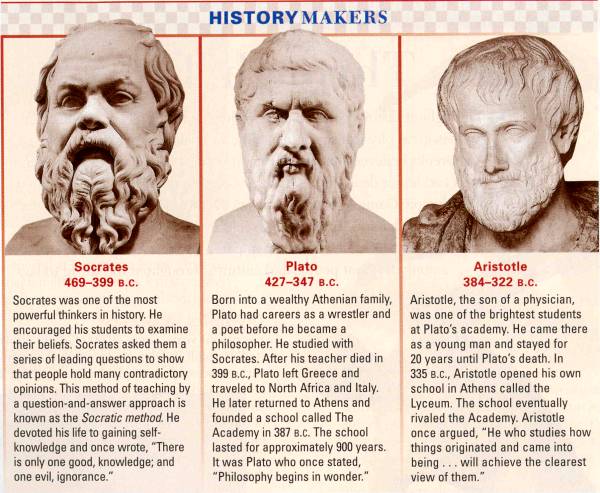
SOCRATES (470-399)
was the son of a sculptor and a midwife, and served with distinction in the Athenian army during Athens’ clash with Sparta. He married, but had a tendency to fall in love with handsome young men, in particular a young soldier named Alcibiades. He was, by all accounts, short and stout, not given to good grooming, and a lover of wine and conversation. His famous student, Plato, called him “the wisest, and justest, and best of all men whom I have ever known”
(Phaedo is one of the best-known dialogues of Plato's middle period, along with the Republic and the Symposium. The Phaedo, which depicts the death of Socrates, is also Plato's fourth and last dialogue to detail the philosopher's final days, following Euthyphro, Apology, and Crito.).
He was irritated by the Sophists and their tendency to teach logic as a means of achieving self-centered ends, and even more their promotion of the idea that all things are relative. It was the truth that he loved, desired, and believed in.
Philosophy, the love of wisdom, was for Socrates itself a sacred path, a holy quest -- not a game to be taken lightly. He believed -- or at least said he did in the dialog Meno - is a Socratic dialogue written by Plato. It appears to attempt to determine the definition of virtue, or arete, meaning virtue in general, rather than particular virtues, such as justice or temperance. - in the reincarnation of an eternal soul which contained all knowledge. We unfortunately lose touch with that knowledge at every birth, and so we need to be reminded of what we already know (rather than learning something new).
He said that he did not teach, but rather served, like his mother, as a midwife to truth that is already in us! Making use of questions and answers to remind his students of knowledge is called maieutics (midwifery), dialectics, or the Socratic method.
One example of his effect on philosophy is found in the dialog Euthyphro - is a dialogue that occurs in the weeks before the Trial of Socrates (399 BCE), for which Socrates and Euthyphro attempt to establish a definitive meaning for the word piety (holiness). He suggests that what is to be considered a good act is not good because gods say it is, but is good because it is useful to us in our efforts to be better and happier people. This means that ethics is no longer a matter of surveying the gods or scripture for what is good or bad, but rather thinking about life. He even placed individual conscience above the law -- quite a dangerous position to take!
Socrates himself never wrote any of his ideas down, but rather engaged his students -- wealthy young men of Athens -- in endless conversations. In exchange for his teaching, they in turn made sure that he was taken care of. Since he claimed to have few needs, he took very little, much to his wife Xanthippe’s distress.
Plato reconstructed these discussions in a great set of writings known as the Dialogs. It is difficult to distinguish what is Socrates and what is Plato in these dialogs, so we will simply discuss them together.
Socrates wasn’t loved by everyone by any means. His unorthodox political and religious views gave the leading citizens of Athens the excuse they needed to sentence him to death for corrupting the morals of the youth of the city. In 399, he was ordered to drink a brew of poison hemlock, which he did in the company of his students. The event is documented in Plato's Apology.
Socrates' final words were "Crito, we owe a cock to Asclepius (the god of medicine). Pay it and do not neglect it."
"The unexamined life is not worth living." -- Socrates
PLATO (437-347)
was Socrates’ prized student. From a wealthy and powerful family, his actual name was Aristocles -- Plato was a nickname, referring to his broad physique. When he was about twenty, he came under Socrates’ spell and decided to devote himself to philosophy. Devastated by Socrates’ death, he wandered around Greece and the Mediterranean and was taken by pirates. His friends raised money to ransom him from slavery, but when he was released without it, they bought him a small property called Academus to start a school -- the Academy, founded in 386.
The Academy was more like Pythagorus’ community -- a sort of quasi-religious fraternity, where rich young men studied mathematics, astronomy, law, and, of course, philosophy. It was free, depending entirely on donations. True to his ideals, Plato also permitted women to attend! The Academy would become the center of Greek learning for almost a millennium.
Plato can be understood as idealistic and rationalistic, much like Pythagorus but much less mystical. He divides reality into two: On the one hand we have ontos, idea or ideal. This is ultimate reality, permanent, eternal, spiritual. On the other hand, there’s phenomena, which is a manifestation of the ideal. Phenomena are appearances -- things as they seem to us -- and are associated with matter, time, and space.
Phenomena are illusions which decay and die. Ideals are unchanging, perfect. Phenomena are definitely inferior to Ideals! The idea of a triangle -- the defining mathematics of it, the form or essence of it -- is eternal. Any individual triangle, the triangles of the day-to-day experiential world, are never quite perfect: They may be a little crooked, or the lines a little thick, or the angles not quite right.... They only approximate that perfect triangle, the ideal triangle.
If it seems strange to talk about ideas or ideals as somehow more real than the world of our experiences, consider science. The law of gravity, 1+1=2, “magnets attract iron,” E=mc2, and so on -- these are universals, not true for one day in one small location, but true forever and everywhere! If you believe that there is order in the universe, that nature has laws, you believe in ideas!
Ideas are available to us through thought, while phenomena are available to us through our senses. So, naturally, thought is a vastly superior means to get to the truth. This is what makes Plato a rationalist, as opposed to an empiricist, in epistemology.
Senses can only give you information about the ever-changing and imperfect world of phenomena, and so can only provide you with implications about ultimate reality, not reality itself. Reason goes straight to the idea. You “remember,” or intuitively recognize the truth, as Socrates suggested in the dialog Meno.
According to Plato, the phenomenal world strives to become ideal, perfect, complete. Ideals are, in that sense, a motivating force. In fact, he identifies the ideal with God and perfect goodness. God creates the world out of materia (raw material, matter) and shapes it according to his “plan” or “blueprint” -- ideas or the ideal. If the world is not perfect, it is not because of God or the ideals, but because the raw materials were not perfect. I think you can see why the early Christian church made Plato an honorary Christian, even though he died three and a half centuries before Christ!
Plato applies the same dichotomy to human beings: There’s the body, which is material, mortal, and “moved” (a victim of causation). Then there’s the soul, which is ideal, immortal, and “unmoved” (enjoying free will).
The soul includes reason, of course, as well as self-awareness and moral sense. Plato says the soul will always choose to do good, if it recognizes what is good. This is a similar conception of good and bad as the Buddhists have: Rather than bad being sin, it is considered a matter of ignorance. So, someone who does something bad requires education, not punishment.
The soul is drawn to the good, the ideal, and so is drawn to God. We gradually move closer and closer to God through reincarnation as well as in our individual lives. Our ethical goal in life is resemblance to God, to come closer to the pure world of ideas and ideal, to liberate ourselves from matter, time, and space, and to become more real in this deeper sense. Our goal is, in other words, self-realization.
Plato talks about three levels of pleasure. First is sensual or physical pleasure, of which sex is a great example. A second level is sensuous or esthetic pleasure, such as admiring someone’s beauty, or enjoying one’s relationship in marriage. But the highest level is ideal pleasure, the pleasures of the mind. Here the example would be Platonic love, intellectual love for another person unsullied by physical involvement.
Paralleling these three levels of pleasure are three souls. We have one soul called appetite, which is mortal and comes from the gut. The second soul is called spirit or courage. It is also mortal, and lives in the heart. The third soul is reason. It is immortal and resides in the brain. The three are strung together by the cerebrospinal canal.
Plato is fond of analogies. Appetite, he says, is like a wild horse, very powerful, but likes to go its own way. Spirit is like a thoroughbred, refined, well trained, directed power. And reason is the charioteer, goal-directed, steering both horses according to his will.
Other analogies abound, especially in Plato’s greatest work, The Republic. In The Republic, he designs (through Socrates) a society in order to discover the meaning of justice. Along the way, he compares elements of his society (a utopia, Greek for “no place”) to the three souls: The peasants are the foundation of the society. They till the soil and produce goods, i.e. take care of society’s basic appetites. The warriors represent the spirit and courage of the society. And the philosopher kings guide the society, as reason guides our lives.
Before you assume that we are just looking at a Greek version of the Indian caste system, please note: Everyone’s children are raised together and membership in one of the three levels of society is based on talents, not on one’s birth parents! And Plato includes women as men’s equals in this system.
ARISTOTLE (384-322)
was born in a small Greek colony in Thrace called Stagira. His father was a physician and served the grandfather of Alexander the Great. Presumably, it was his father who taught him to take an interest in the details of natural life.
He was Plato’s prize student, even though he disagreed with him on many points. When Plato died, Aristotle stayed for a while with another student of Plato, who had made himself a dictator in northern Asia Minor. He married the dictator’s daughter, Pythias. They moved to Lesbos, where Pythias died giving birth to their only child, a daughter. Although he married again, his love for Pythias never died, and he requested that they be buried side by side.
For four years, Aristotle served as the teacher of a thirteen year old Alexander, son of Philip of Macedon. In 334, he returned to Athens and established his school of philosophy in a set of buildings called the Lyceum (from a name for Apollo, “the shepherd”). The beautiful grounds and covered walkways were conducive to leisurely walking discussions, so the students were known as peripatoi (“covered walkways”).
First, we must point out that Aristotle was as much a scientist as a philosopher. He was endlessly fascinated with nature, and went a long way towards classifying the plants and animals of Greece. He was equally interested in studying the anatomies of animals and their behavior in the wild.
Aristotle also pretty much invented modern logic. Except for its symbolic form, it is essentially the same today.
Let’s begin with metaphysics: While Plato separates the ever-changing phenomenal world from the true and eternal ideal reality, Aristotle suggests that the ideal is found “inside” the phenomena, the universals “inside” the particulars.
What Plato called idea or ideal, Aristotle called essence, and its opposite, he referred to as matter. Matter is without shape or form or purpose. It is just “stuff.” pure potential, no actuality. Essence is what provides the shape or form or purpose to matter. Essence is “perfect,” “complete,” but it has no substance, no solidity. Essence and matter need each other!
Essence realizes (“makes real”) matter. This process, the movement from formless stuff to complete being, is called entelechy, which some translate as actualization.
There are four causes that contribute to the movement of entelechy. They are answers to the question “why?” or “what is the explanation of this?”
1. The material cause: what something is made of.
2. The efficient cause: the motion or energy that changes matter.
3. The formal cause: the thing’s shape, form, or essence; its definition.
4. The final cause: its reason, its purpose, the intention behind it.
The material cause: The thing’s matter or substance. Why a bronze statue? The metal it is made of. Today, we find an emphasis on material causation in reductionism, explaining, for example, thoughts in terms of neural activity, feelings in terms of hormones, etc. We often go down a “level” because we can’t explain something at the level it’s at.
The efficient cause: The motion or energy that changes matter. Why the statue? The forces necessary to work the bronze, the hammer, the heat, the energy.... This is what modern science focuses on, to the point where this is what cause now tends to mean, exclusively. Note that modern psychology usually relies on reductionism in order to find efficient causes. But it isn’t always so: Freud, for example, talked about psychosexual energy and Skinner talked about stimulus and response.
The formal cause: The thing’s shape, form, definition, or essence. Why the statue? Because of the plan the sculptor had for the bronze, it’s shape or form, the non-random ordering of it’s matter. In psychology, we see some theorists focus on structure -- Piaget and his schema, for example. Others talk about the structure inherent in the genetic code, or about cognitive scripts.
The final cause: The end, the purpose, the teleology of the thing. Why the statue? The purpose of it, the intention behind making it. This was popular with medieval scholars: They searched for the ultimate final cause, the ultimate purpose of all existence, which they of course labeled God! Note that, outside of the hard sciences, this is often the kind of cause we are most interested in: Why did he do it, what was his purpose or intention? E.g. in law, the bullet may have been the “efficient” cause of death, but the intent of the person pulling the trigger is what we are concerned with. When we talk about intentions, goals, values, and so on, we are talking about final causes.
Aristotle wrote the first book on psychology (as a separate topic from the rest of philosophy). It was called, appropriately, Para Psyche, Greek for “about the mind or soul.” It is better known in the Latin form, De Anima. In this book, we find the first mentions of many ideas that are basic to psychology today, such as the laws of association.
In it, he says the mind or soul is the “first entelechy” of the body, the “cause and principle” of the body, the realization of the body. We might put it like this: The mind is the purposeful functioning of the nervous system.
Like Plato, he postulates three kinds of souls, although slightly differently defined. There is a plant soul, the essence of which is nutrition. Then there is an animal soul, which contains the basic sensations, desire, pain and pleasure, and the ability to cause motion. Last, but not least, is the human soul. The essence of the human soul is, of course, reason. He suggests that, perhaps, this last soul is capable of existence apart from the body.
He foreshadowed many of the concepts that would become popular only two thousand years later. Libido, for example: “In all animals... it is the most natural function to beget another being similar to itself... in order that they attain as far as possible, the immortal and divine.... This is the final cause of every creatures natural life.”
And the struggle of the id and ego: “There are two powers in the soul which appear to be moving forces -- desire and reason. But desire prompts actions in violation of reason... desire... may be wrong.”
And the pleasure principle and reality principle: “Although desires arise which are opposed to each other, as is the case when reason and appetite are opposed, it happens only in creatures endowed with a sense of time. For reason, on account of the future, bids us resist, while desire regards the present; the momentarily pleasant appears to it as the absolutely pleasant and the absolutely good, because it does not see the future.”
And finally, self-actualization: We begin as unformed matter in the womb, and through years of development and learning, we become mature adults, always reaching for perfection. "So the good has been well explained as that at which all things aim."
“Man is by nature a social animal; an individual who is unsocial naturally and not accidentally is either beneath our notice or more than human. Society is something that precedes the individual. Anyone who either cannot lead the common life or is so self-sufficient as not to need to, and therefore does not partake of society, is either a beast or a god. ”
"Happiness depends on ourselves." More than anybody else, Aristotle enshrines happiness as a central purpose of human life and a goal in itself. As a result he devotes more space to the topic of happiness than any thinker prior to the modern era. Living during the same period as Mencius, but on the other side of the world, he draws some similar conclusions. That is, happiness depends on the cultivation of virtue, though his virtues are somewhat more individualistic than the essentially social virtues of the Confucians. Yet as we shall see, Aristotle was convinced that a genuinely happy life required the fulfillment of a broad range of conditions, including physical as well as mental well-being. In this way he introduced the idea of a science of happiness in the classical sense, in terms of a new field of knowledge.
HAPPINESS AS THE ULTIMATE PURPOSE OF HUMAN EXISTENCE
One of Aristotle's most influential works is the Nicomachean Ethics, where he presents a theory of happiness that is still relevant today, over 2,300 years later. The key question Aristotle seeks to answer in these lectures is "What is the ultimate purpose of human existence?" What is that end or goal for which we should direct all of our activities? Everywhere we see people seeking pleasure, wealth, and a good reputation. But while each of these has some value, none of them can occupy the place of the chief good for which humanity should aim. To be an ultimate end, an act must be self-sufficient and final, "that which is always desirable in itself and never for the sake of something else" (Nicomachean Ethics, 1097a30-34), and it must be attainable by man. Aristotle claims that nearly everyone would agree that happiness is the end which meets all these requirements. It is easy enough to see that we desire money, pleasure, and honor only because we believe that these goods will make us happy. It seems that all other goods are a means towards obtaining happiness, while happiness is always an end in itself.
The Greek word that usually gets translated as "happiness" is eudaimonia, and like most translations from ancient languages, this can be misleading. The main trouble is that happiness (especially in modern America) is often conceived of as a subjective state of mind, as when one says one is happy when one is enjoying a cool beer on a hot day, or is out "having fun" with one's friends. For Aristotle, however, happiness is a final end or goal that encompasses the totality of one's life. It is not something that can be gained or lost in a few hours, like pleasurable sensations. It is more like the ultimate value of your life as lived up to this moment, measuring how well you have lived up to your full potential as a human being. For this reason, one cannot really make any pronouncements about whether one has lived a happy life until it is over, just as we would not say of a football game that it was a "great game" at halftime (indeed we know of many such games that turn out to be blowouts or duds). For the same reason we cannot say that children are happy, any more than we can say that an acorn is a tree, for the potential for a flourishing human life has not yet been realized. As Aristotle says, "for as it is not one swallow or one fine day that makes a spring, so it is not one day or a short time that makes a man blessed and happy." (Nicomachean Ethics, 1098a18)
THE HIERARCHICAL VIEW OF NATURE
In order to explain human happiness, Aristotle draws on a view of nature he derived from his biological investigations. If we look at nature, we notice that there are four different kinds of things that exist in the world, each one defined by a different purpose:
Mineral: rocks, metals and other lifeless things. The only goal which these things seek is to come to a rest. They are "beyond stupid" since they are inanimate objects with no soul
Vegetative: plants and other wildlife. Here we see a new kind of thing emerge,something which is alive. Because plants seek nourishment and growth, they have souls and can be even said to be satisfied when they attain these goals
Animal: all the creatures we study as belonging to the animal kingdom. Here we see a higher level of life emerge: animals seek pleasure and reproduction, and we can talk about a happy or sad dog, for example, to the extent that they are healthy and lead a pleasant life
Human: what is it that makes human beings different from the rest of the animal kingdom? Aristotle answers: Reason. Only humans are capable of acting according to principles, and in so doing taking responsibility for their choices. We can blame Johnny for stealing the candy since he knows it is wrong, but we wouldn't blame an animal since it doesn't know any better.
It seems that our unique function is to reason: by reasoning things out we attain our ends, solve our problems, and hence live a life that is qualitatively different in kind from plants or animals. The good for a human is different from the good for an animal because we have different capacities or potentialities. We have a rationalcapacity and the exercising of this capacity is thus the perfecting of our natures as human beings. For this reason, pleasure alone cannot constitute human happiness, for pleasure is what animals seek and human beings have higher capacities than animals. The goal is not to annihilate our physical urges, however, but rather to channel them in ways that are appropriate to our natures as rational animals.
Thus Aristotle gives us his definition of happiness:
...the function of man is to live a certain kind of life, and this activity implies a rational principle, and the function of a good man is the good and noble performance of these, and if any action is well performed it is performed in accord with the appropriate excellence: if this is the case, then happiness turns out to be an activity of the soul in accordance with virtue. (Nicomachean Ethics, 1098a13)
THE PURSUIT OF HAPPINESS AS THE EXERCISE OF VIRTUE
In this last quote we can see another important feature of Aristotle's theory: the link between the concepts of happiness and virtue. Aristotle tells us that the most important factor in the effort to achieve happiness is to have a good moral character — what he calls "complete virtue." But being virtuous is not a passive state: one must act in accordance with virtue. Nor is it enough to have a few virtues; rather one must strive to possess all of them.
THE GOLDEN MEAN
Aristotle’s ethics is sometimes referred to as “virtue ethics” since its focus is not on the moral weight of duties or obligations, but on the development of character and the acquiring of virtues such as courage, justice, temperance, benevolence, and prudence. And anyone who knows anything about Aristotle has heard his doctrine of virtue as being a “golden mean” between the extremes of excess and deficiency. Courage, for example, is a mean regarding the feeling of fear, between the deficiency of rashness (too little fear) and the excess of cowardice (too much fear). Justice is a mean between getting or giving too much and getting or giving too little. Benevolence is a mean between giving to people who don’t deserve it and not giving to anyone at all. Aristotle is not recommending that one should be moderate in all things, since one should at all times exercise the virtues. One can’t reason "I should be cruel to my neighbor now since I was too nice to him before." The mean is a mean between two vices, and not simply a mean between too much and too little.
Furthermore, the mean is “relative to ourselves,” indicating that one person’s mean may be another person’s extreme. Milo the wrestler, as Aristotle puts it, needs more gruel than a normal person, and his mean diet will vary accordingly. Similarly for the moral virtues. Aristotle suggests that some people are born with weaker wills than others; for these people, it may actually be a mean to flee in battle (the extremes being to get slaughtered or commit suicide). Here we see the flexibility in Aristotle’s account: as soon as he begins to lay down some moral rules, he relaxes them in order to take into consideration the variety and contingency of particular temperaments.
Aristotle’s doctrine of the mean is well in keeping with ancient ways of thinking which conceived of justice as a state of equilibrium between opposing forces. In the early cosmologies, the Universe is stabilized as a result of the reconciliation between the opposing forces of Chaos and Order. The Greek philosopher Heraclitus conceived of right living as acting in accordance with the Logos, the principle of the harmony of opposites; and Plato defined justice in the soul as the proper balance among its parts. Like Plato, Aristotle thought of the virtuous character along the lines of a healthy body. According to the prevailing medical theory of his day, health in the body consists of an appropriate balance between the opposing qualities of hot, cold, the dry, and the moist. The goal of the physician is to produce a proper balance among these elements, by specifying the appropriate training and diet regimen, which will of course be different for every person.
Similarly with health in the soul: exhibiting too much passion may lead to reckless acts of anger or violence which will be injurious to one’s mental well-being as well as to others; but not showing any passion is a denial of one’s human nature and results in the sickly qualities of morbidity, dullness, and antisocial behavior. The healthy path is the “middle path,” though remember it is not exactly the middle, given that people who are born with extremely passionate natures will have a different mean than those with sullen, dispassionate natures. Aristotle concludes that goodness of character is “a settled condition of the soul which wills or chooses the mean relatively to ourselves, this mean being determined by a rule or whatever we like to call that by which the wise man determines it.” (Nicomachean Ethics, 1006b36)
According to Aristotle, what is happiness?
- Happiness is the ultimate end and purpose of human existence
- Happiness is not pleasure, nor is it virtue. It is the exercise of virtue.
- Happiness cannot be achieved until the end of one's life. Hence it is a goal and not a temporary state.
- Happiness is the perfection of human nature. Since man is a rational animal, human happiness depends on the exercise of his reason.
- Happiness depends on acquiring a moral character, where one displays the virtues of courage, generosity, justice, friendship, and citizenship in one's life. These virtues involve striking a balance or "mean" between an excess and a deficiency.
- Happiness requires intellectual contemplation, for this is the ultimate realization of our rational capacities.